Unlacquered Brass Kitchen Faucets: Bridge Faucets, Goosenecks & Cross Handles
The kitchen faucet is the kinetic centerpiece of the culinary workspace. Specifying unlacquered brass kitchen faucets demands understanding how an exposed mixing bridge, high-arc gooseneck spout clearance, and 4-point cross handles perform under constant daily water contact and natural atmospheric patina.
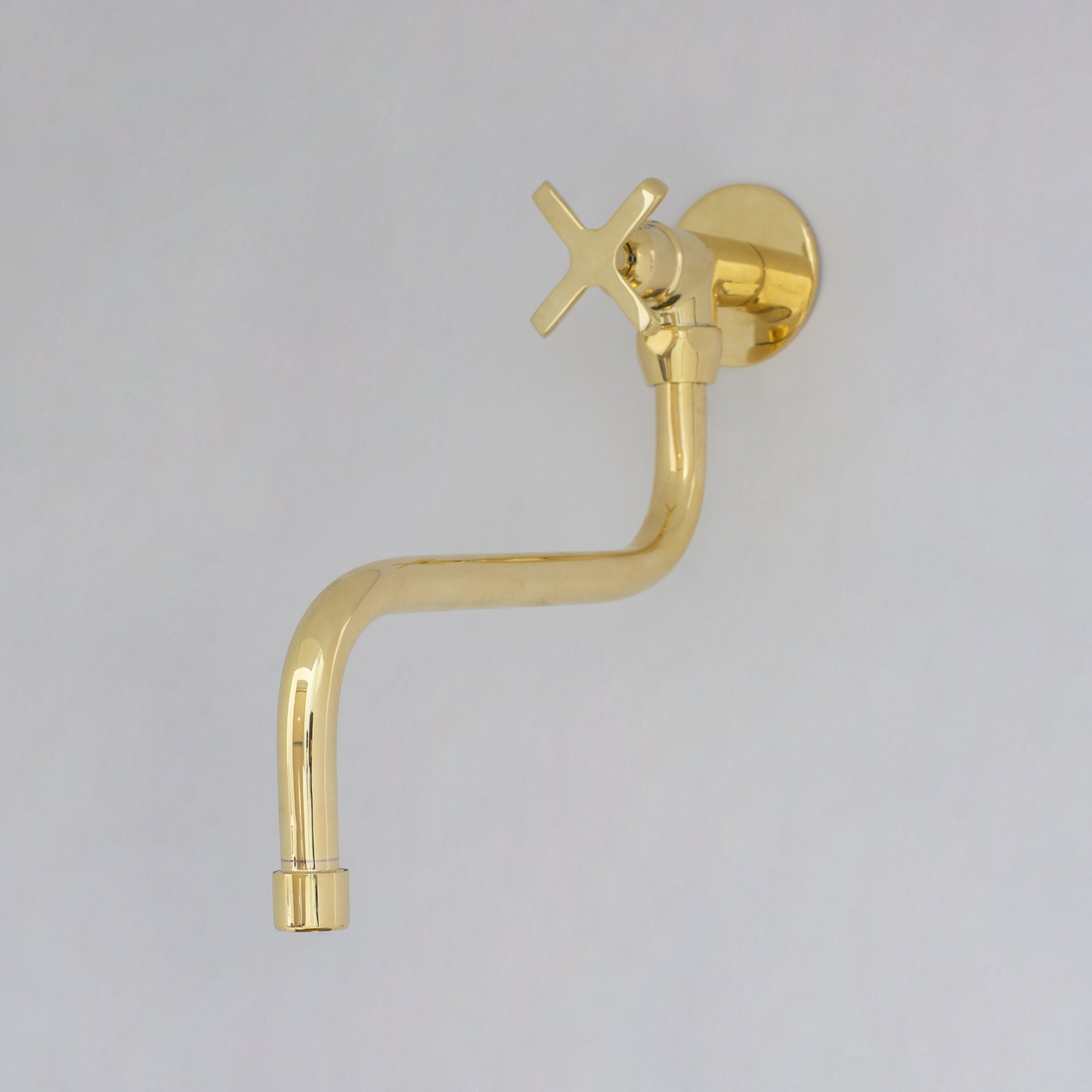
Bridge Architecture vs. Monobloc: The Engineering of Exposed Mixing Chambers
In luxury kitchen design, unlacquered brass kitchen faucets have superseded disposable chrome pull-outs. The premier expression of this revival is the authentic brass bridge faucet.
Originating in 19th-century European commercial kitchens, the exposed bridge design separates the water feeds into two vertical intake legs anchored through the countertop or backsplash. The horizontal bridge acts as an open hydrostatic mixing chamber.
Beyond its commanding visual geometry over fireclay or soapstone apron-front sinks, the dual-leg footprint anchors the fixture securely, eliminating the deck flex and wobble commonly seen with heavy commercial-style single-hole taps.
Spout Geometries & Clearance: High-Arc Goosenecks over Apron Sinks
Spout architecture dictates culinary functionality. High-arc gooseneck spouts rise 11 to 15 inches above the sink rim, providing generous vertical clearance to fill deep 12-quart stockpots and wash oversized Dutch ovens without rim collisions.
A precision 360-degree swivel joint with internal dual Viton O-rings allows smooth articulation across multi-basin prep sinks.
For islands or sinks beneath low-silled window frames, wall mount brass faucet kitchen configurations anchor directly into the stone or subway-tile backsplash. This clears the entire countertop deck for effortless wiping while keeping counter penetrations to zero.
Valve Control Ergonomics: Symmetrical Cross Handles vs. Lever Action
Selecting handle controls influences the daily tactile rhythm of the kitchen. A brass cross handle faucet features four-spoke solid castings, traditionally stamped or inlaid with French or English hot/cold lettering.
Cross handles require a deliberate thumb-and-forefinger grasp, offering tactile resistance and historic accuracy.
Modern ceramic disc cartridges make this operation smooth: a 90-degree 1/4-turn rotation transitions from a trickle to full 1.8 GPM water flow without the multi-turn churning of antique compression valves.
The Wet-Zone Patina: Splashes, Citrus Spots & Natural Self-Healing
Clients specifying unlacquered living brass must embrace its evolving organic character. In the faucet "splash zone," raw brass interacts with tap water minerals, dish soaps, and airborne cooking oils.
Within three to six months, the high-touch handle hubs burnish into radiant golden brass, while the stationary base flanges and neck curve transition into deep, velvety chestnut and antique bronze.
If acidic food droplets cause localized shiny spots, simply wipe dry with a soft cloth. In living brass, oxidation is ongoing: the bright spot will oxidize and harmonize with the surrounding patina naturally.
Specification & Rough-In: Deck Mounting, Wall Flanges & Ceramic Discs
Reliable installation requires coordinating with your plumbing contractor prior to stone countertop fabrication.
Verify that water supply lines feature standard 1/2-inch NPT risers with braided stainless or rigid unlacquered brass supply tubes. Deck stanchions must accommodate countertops up to 1-3/4" thick, including stone build-ups.
By specifying solid sand-cast brass with diamond-lapped ceramic cartridges, the homeowner secures a centerpiece faucet built to deliver decades of drip-free culinary service.
Conservator's PrincipleNever introduce abrasive steel wool or caustic ammonia-based bathroom cleaners to raw unlacquered brass. Warm water with natural soap cleans dirt without stripping accumulated antique patina; a 30-second wipe with jeweler’s rouge or brass paste resets to Day 01 mirror gold anytime.
Frequently Addressed Inquiries
What is the mechanical difference between a bridge faucet and a monobloc faucet?
A bridge faucet incorporates an exposed elevated horizontal pipe that visibly joins the separate hot and cold intake stanchions, mixing the water before channeling it upward into the spout. Monobloc faucets conceal this mixing inside a single central casting. The twin-post bridge design offers superior mechanical stability and classic architectural presence over large apron sinks.
Are brass cross handles or lever handles better for culinary kitchens?
Cross handles provide fine-tuned water flow control and balanced vintage symmetry with porcelain or engraved H/C indices. Lever handles, however, allow hands-free operation using a wrist or forearm when hands are messy from food prep. Both configurations utilize modern 1/4-turn ceramic disc valves for frictionless actuation.
How does unlacquered brass react to water splashes and acidic kitchen ingredients?
Unlacquered brass is a dynamic living metal. Splashes of lemon juice, wine, or vinegar dissolve surface oxidation, leaving temporary bright yellow spots. Because the metal is raw solid brass throughout, these spots naturally oxidize and blend back into the surrounding caramel-bronze patina within two weeks without requiring chemical refinishing.
What hole spread is required to install an 8-inch bridge kitchen faucet?
Standard deck-mounted bridge faucets require two 1-3/8" (35mm) countertop boreholes drilled at an exact 8-inch (203mm) center-to-center spread. Wall-mount culinary installations require matching 8-inch rough-in plumbing behind the backsplash with standard 1/2-inch NPT female drop-ear elbows.
Handcrafted Brass Featured in This Study


