Does Brass Patina? The 30-Day to 1-Year Visual Aging Timeline
Yes, solid unlacquered brass oxidizes continuously. Unlike lacquered metal trapped under polyurethane, raw architectural brass reacts with ambient air and touch to form an organic protective patina. Explore the four distinct visual stages of living brass from installation through one full year.
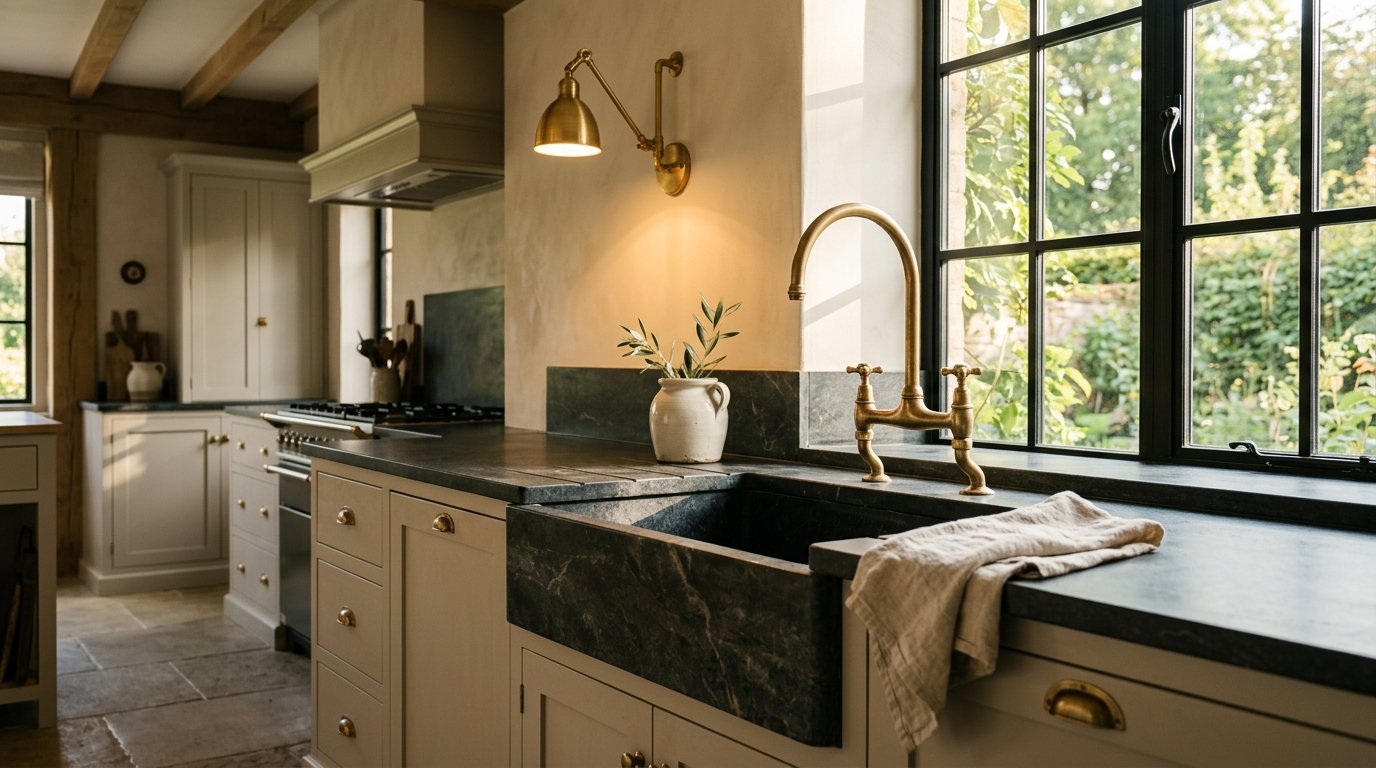
The 365-Day Living Finish Aging Timeline
Day 1: The Virgin Foundry Polish
Freshly sand-cast and hand-buffed in our workshop, the hardware exhibits a warm 18-karat golden radiance with micro-lathed surface reflections.
At this virgin stage, the bare alloy (65% copper, 35% zinc) is fully exposed to ambient air. Fingerprints may leave temporary slight smudges that quickly blend as atmospheric interaction begins.
Day 30: The Honey-Amber Softening
The sharp mirror brilliance gives way to a soft, rich honey glow. High-touch contact surfaces—where fingertips repeatedly grip a drawer pull or turn a pot filler valve—begin to exhibit warm amber depth.
The metal loses its stark commercial sheen, taking on the welcoming warmth of custom architectural craftsmanship.
Day 90: High-Contrast Dimensional Depth
By the third month, the optical contrast between contact points and recessed areas becomes distinct.
Arabesque engravings, backplate borders, and cast fluting deepen into dark caramel and walnut hues, while daily-handled surfaces remain burnished and golden. This natural two-tone depth cannot be replicated by artificial antique spray finishes.
Day 365+: The Settled Heirloom Finish
At one full year, the oxidation reaches equilibrium. The surface settles into an authentic English manor or Moroccan riad character.
The patina is completely stable, velvety to the touch, and naturally resistant to everyday kitchen splatters and bathroom moisture. Most importantly, this finish is living—it self-heals minor scratches through everyday handling.
The 3 Environmental Catalysts That Shape Your Patina
1. Steam and Ambient Humidity (Bathrooms & Wet Rooms)
Water vapor dramatically accelerates copper oxidation. In high-humidity environments like master suites and steam baths, living brass rapidly develops deep, moody bronze tones while remaining completely rustproof.
2. Kitchen Oils and Organic Acids (Stove Backsplashes & Bars)
Olive oil, lemon juice droplets, and cooking steam interact dynamically with raw brass. Acidic splashes create brief bright spots that naturally oxidize back to match the surrounding patina within 10 to 14 days.
3. Contact Burnishing (Doors, Drawers, and Wall Hooks)
Human hands contain natural micro-oils. The friction of daily touch continuously buffs raised edges into radiant golden highlights, creating an organic map of your home's daily life.
Infinite Restorability: The 60-Second Mirror Reset
The greatest advantage of solid unlacquered brass over lacquered or plated metal is that you are never locked into a single look.
If you ever desire the bright, reflective gold of Day 1, applying a pea-sized drop of metal polishing cream (such as Flitz, Cape Cod, or Brasso) dissolves surface oxidation in 60 seconds. Solid brass grants you complete aesthetic freedom for generations.
Conservator's PrincipleNever introduce abrasive steel wool or caustic ammonia-based bathroom cleaners to raw unlacquered brass. Warm water with natural soap cleans dirt without stripping accumulated antique patina; a 30-second wipe with jeweler’s rouge or brass paste resets to Day 01 mirror gold anytime.
Frequently Addressed Inquiries
How fast does unlacquered brass patina?
Noticeable oxidation begins within 7 to 14 days on high-touch surfaces such as door knobs, cabinet pulls, and faucet levers. A stable, mature antique patina develops between 6 and 12 months, depending on ambient humidity and handling.
Does bathroom steam speed up brass patina?
Yes. Moisture and warm water vapor act as natural catalysts for the copper-oxygen reaction. Unlacquered brass installed in a master bathroom or steam shower typically patinas twice as fast as identical hardware in a dry bedroom.
Can you stop or freeze the patina at a specific point?
Yes. If your brass reaches your ideal tone (such as the warm golden-brown hue at Day 90), applying a micro-thin coat of Renaissance Microcrystalline Wax seals the surface from oxygen and moisture, freezing the patina for 12 to 24 months.
Does the patina weaken or degrade the brass over time?
No. Brass contains no iron, so it cannot rust. The patina is a microscopic cuprite (Cu2O) passivation layer that physically shields the underlying alloy from corrosion. In European estates and historic riads, unlacquered brass fixtures remain structurally sound after centuries.
Handcrafted Brass Featured in This Study


